
The September deadlines have started to pass. Some quietly, some noisily. Here’s what actually matters for UK small businesses since the last round-up – with the least amount of panic possible.
TL;DR: The Five Things Worth Knowing
| # | What Changed | When | Who It Affects | Urgency |
|---|---|---|---|---|
| 1 | Google’s /goto redirect confirmed across search results | Confirmed 26 Aug, near-full rollout | Anyone using rank tracking tools or GA4 attribution | 🟠 High |
| 2 | AI Overviews got significantly bigger (dynamic expansion + generative UI) | 19 Aug and 27–28 Aug | Every business with informational or how-to content | 🔴 Critical |
| 3 | ChatGPT changed how it searches the web overnight | 8 Aug (still playing out) | Anyone chasing AI citations | 🟠 High |
| 4 | Parasite SEO enforcement paused inside the EEA (but not the UK) | 30 Aug | UK sites competing against EU-hosted parasite content | 🟡 Medium |
| 5 | Google Content API for Shopping starts failing | Progressive from 1 Sept | Ecommerce sites with old Merchant Center integrations | 🟠 High |
1. Google’s /goto Redirect: Your Rank Tracker Might Be Lying
Hover over any Google search result now. The link no longer points to the site you’re about to visit. It goes to google.com/goto?url=... first, then bounces to the destination.
Google confirmed this on 26 August. By late August, one SERP tracking firm (Nozzle) reported the redirect on nearly 100% of results across several residential IP ranges. The change is quiet, the impact is not.
Why this matters for you (even if you don’t scrape SERPs)
There are two knock-on effects worth watching.
The first is rank tracking. Tools that used cheap HEAD requests to resolve destination URLs can’t any more; Google blocks them on /goto links, forcing a full GET request for every single result. One SEO estimated a standard five-page ranking report now takes 500 to 1,000 requests instead of the handful it used to. Which means your tracker either eats the cost or delays your data.
The second, and more important for small business owners, is GA4 attribution. If the redirect strips referrer data on a click, that organic session can quietly reclassify as (direct) / (none). Your organic channel shrinks. Direct traffic swells. Neither number is real.
Who’s affected -and who says they aren’t
| Tool | Impact reported |
|---|---|
| Google Search Console | No impact – still reliable |
| SE Ranking | Confirmed no impact on position tracking |
| Semrush | Confirmed no impact on position tracking |
| Ahrefs | Temporary data inconsistency, fix in progress |
| SerpAPI | Multiple products affected; resolved 5 Sept |
What to do
- Cross-check any recent traffic dip against Search Console before blaming your site. GSC data still comes from the source.
- If your GA4 organic traffic has fallen since late August but Search Console impressions and clicks are stable, that’s the redirect at work – not a ranking loss.
- Ask your rank tracking provider directly whether they’re impacted. They will have an answer, or they’ll be lying to you.
2. AI Overviews Just Ate More of the Page
Two changes landed within about ten days of each other, and together they change how much space Google’s own answer occupies before a searcher ever reaches a blue link.
Change one: Generative UI arrived in AI Overviews (19 August)
Custom visual layouts, interactive tools, calculators, comparison widgets. All built by AI on the fly. Google demonstrated it with a pH scale visualisation. In practice this hits any business built around explainer tools, calculators, converters, comparison tables or interactive guides. If Google can build a working mortgage calculator inside its own answer, a searcher has one less reason to click.
Change two: Dynamic expansion (27–28 August)
AI Overviews can now grow into a longer, AI-Mode-style answer automatically. The manual “Show More” button , the one that used to give you a fighting chance below the fold -has been removed for some queries. Google decides when to expand. You don’t.
Independent tracking put AI Overview presence at around 48% of Google searches in early 2026. Health, education and B2B tech queries can hit 80%. AI Mode sessions themselves end in a click to an external website only about 4.5% of the time, compared with roughly 24% for traditional search. That is not a small delta.
What to actually do
- Assume the top of your service pages will be summarised. Write the first 60 to 80 words as if that’s the only thing Google will show. Get to the answer.
- Check the new Generative AI performance report in Search Console (rolled out worldwide on 31 August). This is the only place you’ll see AI Overview impressions attributed properly.
- If your business runs on interactive tools, treat the tool page like a lead magnet. The tool result itself is now in competition with Google’s own answer, so the value has to sit around it – data, context, next steps.
3. ChatGPT Rewrote How It Searches the Web
On 8 August, ChatGPT started scoping most of its background searches to specific trusted domains instead of the open web. Two independent tracking firms caught it in real time. The chart below shows the scale of the change:
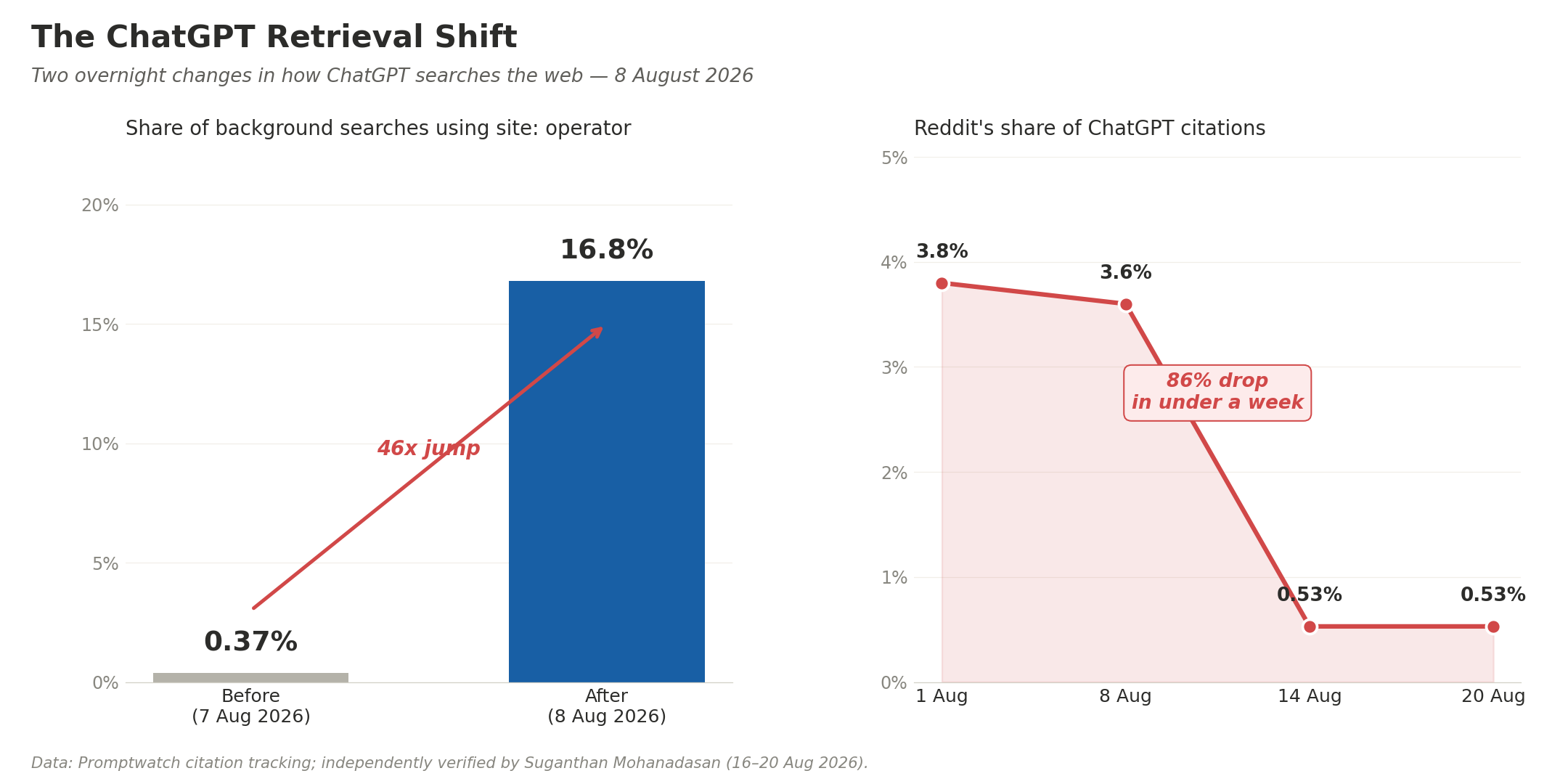
 Data: Promptwatch citation tracking; independently verified by Suganthan Mohanadasan (16–20 Aug 2026).
Between 16 and 20 August, ChatGPT also swapped its search tool from a JSON structure to a compact query language with freshness windows, domain targeting and separate verticals for products, places, images and widgets. Which sounds dry until you notice what it means: ChatGPT is now behaving less like a search engine that reads whatever comes back, and more like a research assistant that already knows which sites to trust for each topic.
What actually changed for citations
Domains that gained ground: official brand sites, documentation, government sources, primary research, standards bodies. Domains that lost: forums, aggregators, Reddit, community discussion sites.
What to do
If getting cited by ChatGPT matters to your business:
- Make sure OAI-SearchBot and ChatGPT-User can crawl your site. Cloudflare’s crawler changes (covered last time) matter here.
- Own your own answers. If someone else’s page is the primary source for a topic in your niche, ChatGPT will scope its search to them and skip you.
- First-party data, original research, and clear factual pages beat blog posts stitched together from other sources. The shift rewards the source, not the summariser.
4. Parasite SEO Enforcement Paused in the EEA (But Not the UK)
From 30 August, Google stopped applying manual actions under its site reputation abuse policy to searchers inside the European Economic Area. That’s the 27 EU states plus Iceland, Norway and Liechtenstein. The change followed a European Commission investigation under the Digital Markets Act.
Here’s the awkward part for UK businesses: the UK is not in the EEA. Post-Brexit, the UK sits outside the change. Google’s enforcement continues here exactly as before.
Which creates a strange competitive dynamic worth understanding.
| Region | Site reputation abuse enforcement (from 30 Aug) |
|---|---|
| UK searchers | Full enforcement third-party content on trusted sites still gets manual actions |
| EU + EEA searchers | Manual actions no longer applied; system may separate section and let it rank on its own |
| Rest of world (US, Canada, Australia, etc.) | Full enforcement continues |
For a UK small business, the practical read is that competitors relying on parasite SEO tactics against your keywords will still be penalised in UK search results. But if your competitors are getting European traffic through EU-hosted parasite pages, that content is now less exposed to enforcement across the channel. Interesting, more than alarming.
Google also clarified four factors it uses to identify site reputation abuse: extent of first-party involvement, integration with the host site, whether the section brings any value to the host site’s users, and whether the content is presented in a way that misleads.
5. Google’s Old Shopping API Starts Failing Today (Well, 1 September)
If you’re on Shopify, WooCommerce, BigCommerce or any modern platform, this probably isn’t your problem most have already migrated. If you’re running a custom-built store, or an older integration, read on.
Google’s Content API for Shopping officially reached its sunset on 18 August. From 1 September, requests from any client without an active extension start failing intermittently with an HTTP 410 error. Full shutdown is scheduled for early 2027.
What to do
- Ask your developer or agency whether your Merchant Center feed uses the Merchant API (new, still working) or Content API for Shopping (old, now failing).
- If it’s the old one, you can request an extension via Google’s form. Don’t wait for products to start disappearing from Shopping listings.
- Symptoms to watch for: sudden drops in Merchant Center feed processing, products vanishing from Shopping ads, sync errors in your ecommerce backend.
Quick-Fire Round-Up: The Rest of What Happened
| Update | What Happened | What To Do |
|---|---|---|
| Google Search Console: AI reports go global | The Generative AI performance report is now available in every market as of 31 August | Log in and check impressions from AI Overviews and AI Mode – new data source you haven’t seen before |
| Google Preferred Sources button | An embeddable button (20 Aug) that lets publishers ask readers to prefer them in AI Overviews, AI Mode and Top Stories | Only relevant if you publish news or industry content; if so, drop the button somewhere prominent |
| Meta Ads placement exclusions removed | Meta is removing the option to exclude specific placements from ad sets | Audit brand safety exclusions now -Audience Network placements will be forced back into your delivery |
| Gemini 3.8 Flash added to Google AI Mode | Users can pick 3.8 Flash from the “+” menu in AI Mode’s ask bar | Nothing to action – but useful to know when testing how your business appears in AI Mode responses |
| ChatGPT desktop app updates | Site URL changes without redeploying; Codex chat sharing; Box/Dropbox/SharePoint in Library | Handy if you use ChatGPT Work; low-priority for most small businesses |
The Bigger Picture
Two themes emerged over the last fortnight, and both are worth internalising.
AI is now the source of truth for citations, not the middleman. ChatGPT’s shift towards scoping searches by domain, combined with Google’s expanding AI Overviews, means the sites AI systems already trust for a topic keep getting more visibility. Everyone else has to compete on being the primary source, not a good summariser of primary sources. Original data, first-hand expertise and clear factual pages compound. Rewritten explainers don’t.
Measurement is getting harder before it gets easier. /goto obscures organic attribution. AI Overviews absorb the click. Rank tracking changes accuracy. If you make decisions based only on what a single tool tells you, the odds of making one bad call go up this month. Cross-check Search Console against GA4 against your ecommerce or CRM data before changing anything.
Your Mid-September Action Checklist
- ☐ Cross-check organic traffic in GA4 against Search Console – the
/gotoredirect can misclassify sessions - ☐ Open the Generative AI performance report in Search Console (now global) and note baseline impressions
- ☐ Ask your ecommerce developer whether your Shopping feed uses Merchant API or Content API
- ☐ Audit your top service pages for a clear, extractable answer in the first 60–80 words
- ☐ Check that OAI-SearchBot and ChatGPT-User aren’t blocked at your CDN or firewall
- ☐ Review Meta ad set placement exclusions before they get removed
- ☐ Add fresh content or a photo to your Google Business Profile if it’s been more than 30 days
Final Thought
None of this is an emergency for a well-run small business. Most of it can be checked in a Sunday evening pass through the tools you already use. The real value of a fortnight like this is spotting the pattern – which is that AI systems are getting better at deciding what to show and worse at explaining why. Original content, clear pages, real expertise and clean measurement still win. They just win a bit quieter now.
Sources for this round-up include Search Engine Land, Search Engine Roundtable, Search Engine Journal, Google Search Central Blog, Google Developers documentation, SUSO Digital, Promptwatch, Suganthan Mohanadasan, Nozzle, SerpAPI, and reporting from PPC.land, Digital Applied and Adido Digital. Snapshot as of 15 September 2026.


This is a useful roundup of the latest SEO and digital marketing developments. I liked how the article brings together recent updates in one place, making it easier for marketers to understand what has changed and what may affect their strategies. A helpful read for anyone trying to stay updated with the fast-changing digital marketing landscape.
https://nidmdigitalmarketing.com/
LikeLike
cheers fam
LikeLike