I only want the URLs that reside at the third level – i.e. /productpage/
Go to your XML sitemap – usually at Myshop.com/sitemap.xml
Right click and “save as” – save on your computer
Open Excel
Go to the Developer Tab (you might need to add this as it’s not there by default)
Click “Import”
Browse to find your sitemap.xml and import it into Excel
This usually pulls all your URLs into column 1 and other info like priority into separate columns
Delete all the columns except the first one with your URLs in it
Remove the https:// from the URLs with “find and replace” – On “Home” tab under “Find & Select” on the right
In cell B2 add the function: (change A2 – to the cell you have put the first URL in)
=LEN(A2)-LEN(SUBSTITUTE(A2,"/",""))
11. Drag the formula down the rest of column B
12. You can now order column B by the number of “/” found in each URL
If different categories have different folder structures then you can conditionally format and use different colours for different categories and then do a multiple criteria sort – by colour, then folder depth (column B)
You can download an example spreadsheet with the formula in here
The idea of technical SEO is to minimise the work of bots when they come to your website to index it on Google and Bing. Look at the build, the crawl and the rendering of the site.
To get started:
Crawl with Screaming Frog with “Text” Rendering – check all the structured data options so you can check schema (under Configuration – Spider – Extraction)
Crawl site with Screaming Frog with “JavaScript” rendering also in a separate or second crawl
Don’t crawl the sitemap.xml
This allows you to compare the JS and HTML crawls to see if JS rendering is required to generate links, copy etc.
Download the sitemap.xml – import into Excel – you can then check sitemap URLs vs crawl URLs.
Check “Issues” report under Bulk Export menu for both crawls
Also download or copy and paste sitemap URLs into Screaming Frog in list mode – check they all result in 200 status
*Great for tailoring copy and pages. Just turn it on and add query parameter
Summary:
– Perform a crawl with Screaming Frog – In Configuration – Crawl – Rendering – Crawl once with Text only and once with JavaScript
Check indexation with site: searches including:
site:example.com -inurl:www
site:*.example.com -inurl:www
site:example.com -inurl:https
– Search screaming frog crawl – for “http:” on the “internal” tab – to find any unsecure URLs
*Use a chrome plug in to disable JS and CSS*
Check pages with JS and CSS disabled – Are all the page elements visible? Do Links work?
Configuration Checks
Check all the prefixes – http, https and www redirect (301) to protocol your using – e.g. https://www.
Does trailing slash added to URL redirect back to original URL structure?
Is there a 404 page?
Robots & Sitemap
Is Robots.txt present?
Is sitemap.xml present? (and in the sitemap)
Is Sitemap Submitted in S.C.?
X-robots present?
Are all the sitemaps naming conventions in lower case?
Are the URLs correct in the sitemap – correct domain and correct URL structure?
Do sitemap URLs all 200? (including images) List Mode in Screaming Frog – “Upload” – Download sitemap – “ok”
For site migrations check – Old sitemap and Crawl Vs New – For example, Magento 1 website sitemap vs Magento 2 – anything missing or added – what are status codes?
– Status Codes – any 404s or redirects in SCreaming Frog crawl?
Rendering Check – Screaming Frog – also check pages with JS and CSS disable. Check links are present and work
Are HTML Links and H1s in the rendered HTML – check URL Inspection in Search Console or Mobile Friendly text?
Do pages work with JS disabled – links and images visible etc?
What hreflang links are present on the site?
Schema – Check all schema reports in Screaming Frog for errors
Sitemap Checks Are crawl URLs missing from the sitemap? (check sitemap Vs crawl URLs that 200 and are “indexable”
Site: scrape How many pages are indexed?
Do all the scraped URLs result in a 200 status code?
H1s Are any duplicate H1s? Are any pages missing H1s? Any multiple H1s?
Images Are any images missing alt text? Are any images too big in terms of KB?
Canonicals Are there any non-indexable canonical URLs?
Are any canonicals canonicalised? e.g. pages with different canonicals that arent simples/config products
URL structure Errors
Meta Descriptions Are any meta descriptions too short? Are anymeta descriptions too long? Are any meta descriptions duplicated?
Meta Titles Are any meta titles too short? Are anymeta titles too long? Are any meta titles duplicated?
Robots tags blocking any important pages?
Menu Is the menu functioning properly?
Pagination Functioning fine for UX? Canonical to root page?
Check all the issues in the issues report in Screaming Frog
PageSpeed Checks Lighthouse – check homepage plus 2 other pages
GTMetrix
pingdom
Manually check homepage, listing page, product page for speed
Dev Tools Checks (advanced) Inspect main elements – are they visible in the inspect window? e.g. right click and inspect the Headings – check has meta title and desc Check on mobile devices Check all the elements result in a 200 – view the Network tab
Console tab – refresh page – what issues are flagged? Unused JS in the elements tab – coverage
other Checks
Has redirect file been put in place? Have hreflang tags for live sites been added? Any meta-refresh redirects!?
Tech SEO 1 – The Website Build & Setup
The website setup – a neglected element of many SEO tech audits.
Storage Do you have enough storage for your website now and in the near future? you can work this out by taking your average page size (times 1.5 to be safe), multiplied by the number of pages and posts, multiplied by 1+growth rate/100
for example, a site with an average page size of 1mb with 500 pages and an annual growth rate of 150%
1mb X 1.5 X 500 X 1.5 = 1125mb of storage required for the year.
You don’t want to be held to ransom by a webhost, because you have gone over your storage limit.
How is your site Logging Data? Before we think about web analytics, think about how your site is storing data. As a minimum, your site should be logging the date, the request, the referrer, the response and the User Agent – this is inline with the W3 Extended Format.
When, what it was, where it came from, how the server responded and whether it was a browser or a bot that came to your site.
Blog Post Publishing Can authors and copywriters add meta titles, descriptions and schema easily? Some websites require a ‘code release’ to allow authors to add a meta description.
Site Maintenance & Updates – Accessibility & Permissions Along with the meta stuff – how much access does each user have to the code and backend of a website? How are permissions built in? This could and probably should be tailored to each team and their skillset.
For example, can an author of a blog post easily compress an image? Can the same author update a menu (often not a good idea) Who can access the server to tune server performance?
Tech SEO 2 – The Crawl
Google Index
Carry out a site: search and check the number of pages compared to a crawl with Screaming Frog.
With a site: search (for example, search in Google for site:businessdaduk.com) – don’t trust the number of pages that Google tells you it has found, scrape the SERPs using Python on Link Clump:
How to scrape Google SERPs in one click – Don’t use LinkClump, use the instructions on my blog post here to make your own SERP extractor
Too many or too few URLs being indexed – both suggest there is a problem.
Correct Files in Place – e.g. Robots.txt Check these files carefully. Google says spaces are not an issue in Robots.txt files, but many coders and SEOers suggest this isn’t the case.
XML sitemaps also need to be correct and in place and submitted to search console. Be careful with the <lastmod> directive, lots of websites have lastmod but don’t update it when they update a page or post.
Response Codes Checking response codes with a browser plugin or Screaming Frog works 99% of the time, but to go next level, try using curl and command line. Curl avoids JS and gives you the response header.
You need to download cURL which can be a ball ache if you need IT’s permission etc.
Anyway, if you do download it and run curl, your response should look like this:
Next enter an incorrect URL and make sure it results in a 404.
Canonical URLs Each ‘resource’ should have a single canonical address.
common causes of canonical issues include – sharing URLs/shortened URLs, tracking URLs and product option parameters.
The best way to check for any canonical issues is to check crawling behaviour and do this by checking log files.
You can check log files and analyse them, with Screaming Frog – the first 1,000 log files can be analysed with the free version (at time of writing).
Most of the time, your host will have your logfiles in the cPanel section, named something like “Raw Access”. The files are normally zipped with gzip, so you might need a piece of software to unzip them or just allow you to open them – although often you can still just drag and drop the files into Screaming Frog.
Lighthouse Use lighthouse, but use in with command line or use it in a browser with no browser add-ons.If you are not into Linux, use pingdom, GTMetrix and Lighthouse, ideally in a browser with no add-ons.
Look out for too much code, but also invalid code. This might include things such as image alt tags, which aren’t marked up properly – some plugins will display the code just as ‘alt’ rather than alt=”blah”
Javascript Despite what Google says, all the SEO professionals that I follow the work of, state that client-side JS is still a site speed problem and potential ranking factor. Only use JS if you need it and use server-side JS.
Use a browser add-on that lets you turn off JS and then check that your site is still full functional.
Schema
Finally, possibly in the wrong place down here – but use Screaming Frog or Deepcrawl to check your schema markup is correct.
You can add schema using the Yoast or Rank Math SEO plugins
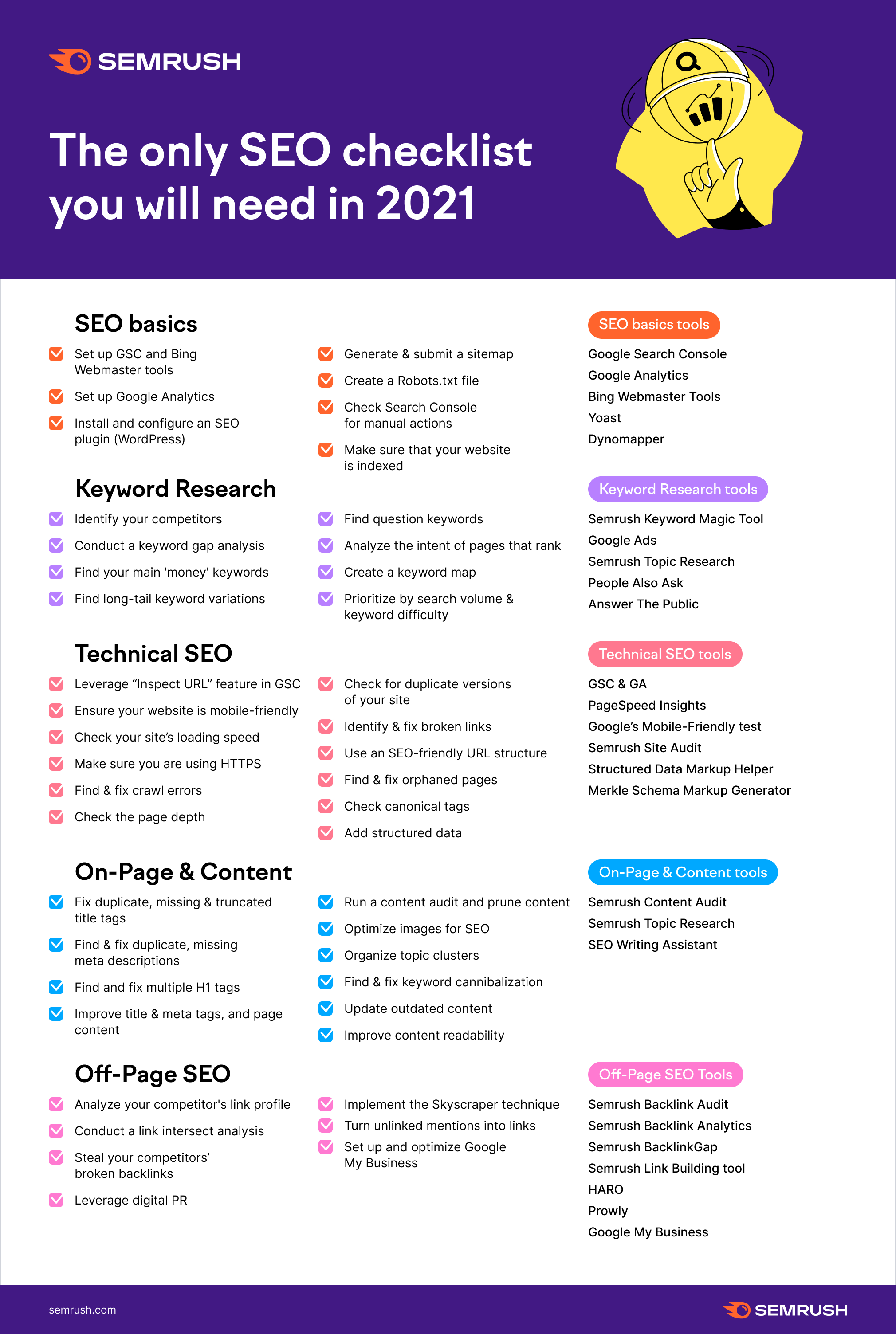
The Actual Tech SEO Checklist (Without Waffle)
Basic Setup
Google Analytics, Search Console and Tag Manager all set up
Site Indexation
Sitemap & Robots.txt set up
Check appropriate use of robots tags and x-robots
Check site: search URLs vs crawl
Check internal links pointing to important pages
Check important pages are only 1 or 2 clicks from homepage
For render blocking JS and stuff, there are WordPress plugins like Autoptimize and the W3 Total Cache.
Make sure there are no unnecessary redirects, broken links or other shenanigans going on with status codes. Use Search Console and Screaming Frog to check.
Site UX
Mobile Friendly Test, Site Speed, time to interactive, consistent UX across devices and browsers
Consider adding breadcrumbs with schema markup.
Clean URLs
Image from Blogspot.com
Make sure URLs – Include a keyword, are short – use a dash/hyphen –
Secure Server HTTPS
Use a secure server, and make sure the unsecure version redirects to it
Allow Google to Crawl Resources
Google wants to crawl your external CSS and JS files. Use “Fetch as Google” in Search Console to check what Googlebot sees.
Hreflang Attribute
Check that you are using and implementing hreflang properly.
Tracking – Make Sure Tag Manager & Analytics are Working
Check tracking is working properly. You can check tracking coed is on each webpage with Screaming Frog.
Internal Linking
Make sure your ‘money pages’ or most profitable pages, get the most internal links
Content Audit
Redirect or unpublish thin content that gets zero traffic and has no links. **note on this, I had decent content that had no visits, I updated the H1 with a celebrity’s name and now it’s one of my best performing pages – so it’s not always a good idea to delete zero traffic pages**
Consider combining thin content into an in depth guide or article.
Use search console to see what keywords your content ranks for, what new content you could create (based on those keywords) and where you should point internal links.
Use Google Analytics data regarding internal site searches for keyword and content ideas 💡
Update old content
Fix meta titles and meta description issues – including low CTR
Find & Fix KW cannibalization
Optimize images – compress, alt text, file name
Check proper use of H1 and H2
See what questions etc. are pulled through into the rich snipetts and answer these within content
Click “Pages” (near the bottom-third of the page on the left)
Click on a high-performing post in terms of Impressions and Clicks in google
With the specific page/post selected, click on queries
Make a note of all relevant queries in the top 100
See if these queries can be added to the ranking post
Find any queries that are not directly related to your post
Create a new post specifically about this/these queries (if you rank for it without a specific post – you’ll rank better with a specific post for that query)
In the original post – put an internal link to the new post
“You’ll never get yourself off the treadmill of paid ads, if you don’t build your brand”
Someone on a Search Podcast, 2019
It’s very easy to dismiss online content, blogs, image assets and even display ads as pretty much useless – because you don’t have the instant gratification of seeing leads and/or sales.
This is completely understandable; especially if you have a background in sales – where your job has been to ‘finish off the lead’ and get a sale.
However, if you are in it for the long (or medium) run, then building your brand is a must. Whether you are a tradesman or a giant corporation, your brand’s reputation and the brand-awareness is your safety net when it comes to consistent website traffic, leads & sales.
It takes time to build a brand – but once it is built, those people who come to you direct because they know who you are – are effectively free – or at least very cheap in comparison to some of the cost per click of Google Search Ads these days.
Building a brand is not easy however. Take my other blog for example – Blackbeltwhitehat.com
The blog has over 600 pages of content, lots of it really long, in-depth and time-consuming to produce. The site has 5,000-10,000 visitors per month, but virtually nobody comes to my website via a branded search on Google.
This could be down to one specific reason – the domain name is crap and hard to remember.
I’ve bought a few more memorable domains (like WokeMMA.com “Woke” being an ironic term for self-awareness used in the MMA & Jiu Jitsu communities) and I am currently weighing up the time & effort of re-branding everything like GoogleMyBusiness, TrustPilot etc. – plus all my back-links currently point to blackbeltwhitehat.com (I’m aware of 301s etc. but I’ll still definitely see a drop in rankings).
My blog is ultimately a hobby that I’ve invested less than $50 into over 6 years. But if I had some more budget – I’d put together a plan to build my brand online…
First make sure you know your target audience & do one of those SWOT analysis. Then make specific goals to establish some brand KPIs.
Here are some ideas on what to do next:
Get a relevant, easy to remember domain name!
Learn from my mistake, a short catchy domain name is an easy-win if you are just starting out from scratch. A lot of the best and obvious domain name will be taken however, so you’ll have to do some research first. If you are just starting out, don’t name your business until you secure your domain name!
Display Ads
Depending on your niche, you can set tiny max CPC bids in some instances – and they’ll still get thousands of impressions for very little spend. Gmail ads work particularly well for (potential) low CPM (cost per 1000 impressions).
Rotate your display ads’ design & colours to stop people ignoring them due to ‘banner blindness’.
Blog & Outreach
Blog are great for reaching people who are researching a potential purchase.
For example, I landed on Perfect Keto’s blog a few times whilst researching Exogenous Ketones. Then ended up buying their branded product on Keto-pro.co.uk; because, for what ever reason, I trusted their brand.
Create great content, with statistics, images and video – and then outreach it – i.e. send it to relevant blogs and websites.
If you can afford it, use “PR-Level” outreach and contact national newspapers etc. This can be done via websites such as gorkana
If you content gets links too – then great – that’s good for Search Engine Optimisation (SEO). Doing some of your own exclusive research and generating tables of statistics are great for generating back-links naturally i.e. passively.
So consider doing some market research using Google surveys etc. These guys calculated RV/Campervan depreciation in value, just by looking at vehicles for sale online and get hundreds of back-links.
To turn blog’s into direct sales, you can also use relevant ‘CTA’ images below your blog.
For example, if you post a blog about the Walking Path’s of Snowdonia on your Snowdonia-based-bed-&-breakfast website; consider adding a relevant & clickable ‘book now’ and/or ‘get your free brochure’ button with eye-catching image at the bottom of the post. Many people now do this with newsletter sign up pop ups, which are a bit annoying but do work.
Content is great – but tools tend to do better than copy. For example, NerdWallet’s top page in terms of organic traffic – is their mortgage calculator.
Reviews
As well as brand awareness, you want some social-proofing of your brand. Start with a free account on Trustpilot and GoogleMyBusiness
Video & Social Media
The number 1 mistake people make on social media is to harp on about their brand all the time. Be entertaining, provide useful information and insightful comments. If you are over-promotional, people will not follow you. Build some authority by providing helpful insights that your target market will appreciate.
Videos & podcasts can be costly in terms of time. If you don’t want to set up your own podcast, guest-appearance on other people’s podcasts can generate valuable awareness and also back-links to your website (important for Search Engine Optimisation/Rankings).
Build an amazing product and/or service
This is your foundation and one of the reasons that Apple is so successful. An LSD-fueled Steve Jobs came up with some amazing ideas and concepts. The brand also turned itself into unique hybrid of tech & fashion thanks to their pioneering products.
The big, light-up apple on the back of Macbooks no doubt was a design aimed at building brand awareness too!
Please note – I realise this blog has a rubbish social media following. But that’s due to lack of time/money investment. I generally just use this blog as somewhere to record my thoughts & to remember how to do all things marketing related. E.g. here are my notes so I remember how to use Screaming Frog to scrape OG tags.
When someone goes about starting a business, the nervousness and the excitement is highly motivating, and it’s easy to get straight stuck into doing all the interesting stuff, like the marketing, sorting out the website and creating your company logo.
It is important however, to get the basics in place first, and to give the fundamentals, and the ‘boring stuff’ the same thought, care and enthusiasm as the more interesting and rewarding elements of starting your own company.
Choosing the right accountant for example, is not the most exciting task, but can be pivotal in regards to your businesses success. It’s pretty interesting, but also a bit worrying, that any Joe Bloggs can call him or herself an accountant without any relevant credentials or qualifications. In spite of this fact, very few business owners speak to a number of potential accountants, or research around them and their reputation. This is potentially a huge mistake.
Ensure that any accountant you are considering hiring, are qualified through one of the main associations/accrediting bodies such as the Institute of Chartered Accountants (ICAEW),the Chartered Institute of Management Accountants (CIMA), or the Association of Chartered Certified Accountants (ACCA).
It goes without saying, or it should do, that you should also look into how you will pay your accountant. Are there set fees, or does he/she charge an hourly rate? If possible choose someone that can audit and advise you in regards to your business, as well as being a bookkeeper. Ideally your accountant will have experience in your business sector; but not conflicts of interest.
Ensure that you do not choose an accountant, just because they are situated right next to your office. It is an important decision, that should not be just a quick decision or after-thought. They will after all, be in charge of your money. Look what happened to Mike Tyson! (he wasn’t screwed over by an accountant, but still…).
I live in North Wales, right on the border with England, and my accountant is based in Chester. It’s definitely worth looking outside your home town. I did have an accountant based in Wrexham, but it was impossible to speak to, or get in touch with him, via phone or email, so he may of well be based in Australia. Good customer service and ‘contactability’ are also crucial.
The Disability Discrimination Act (DDA) states that businesses that provide ‘goods and services’ must make ‘reasonable adjustments’ for disabled people.
The DDA may influence your entire business, from how you treat your staff, people who apply for jobs at your business, and of course – your customers. If you fail to do what is deemed as reasonable to adapt your business to the needs of disabled people, then legal action could be taken against you.
If you’re not motivated by compliance with the law (or the ethics behind disability access), a free service created by directenquiries.com allows businesses with ‘good’ access and facilities for people with disabilities to be listed on their directory.
Direct Enquiries will also provide an action plan to identify areas that need improvement. These are generally simple changes that can be done at low or no cost to the business.
The directory and the corresponding action plan aims to encourage more businesses to improve their access and services, and in doing so, attract more of the UK’s disabled individuals.
In addition to the improvements in disability access (to new buildings and businesses in general); there has been an increase in the sale and manufacture of recreational vehicles and cycles for the disabled, or people with specific needs.
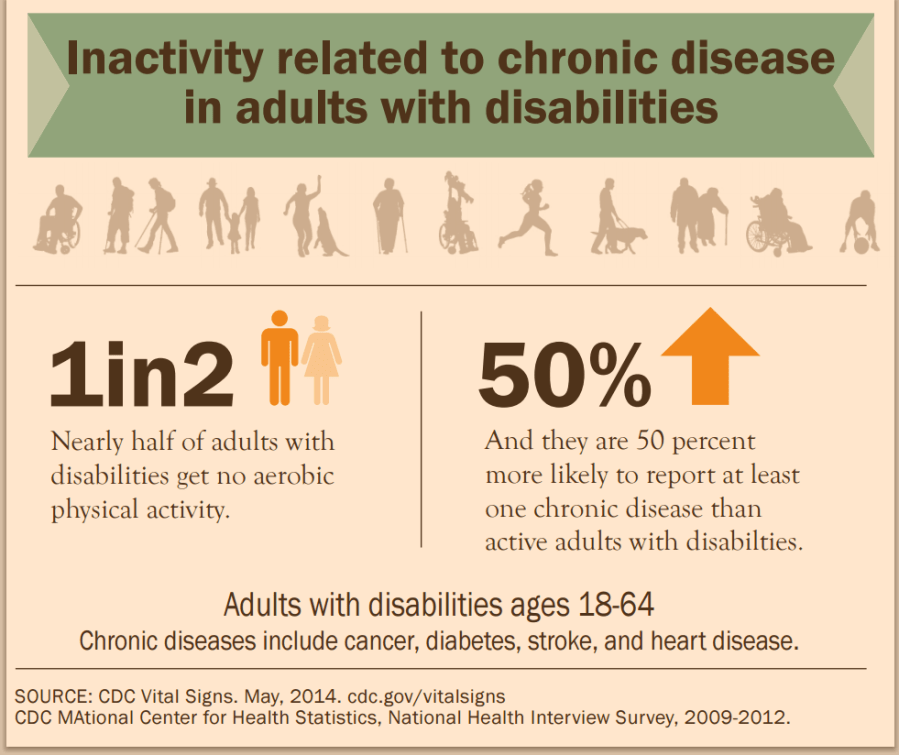
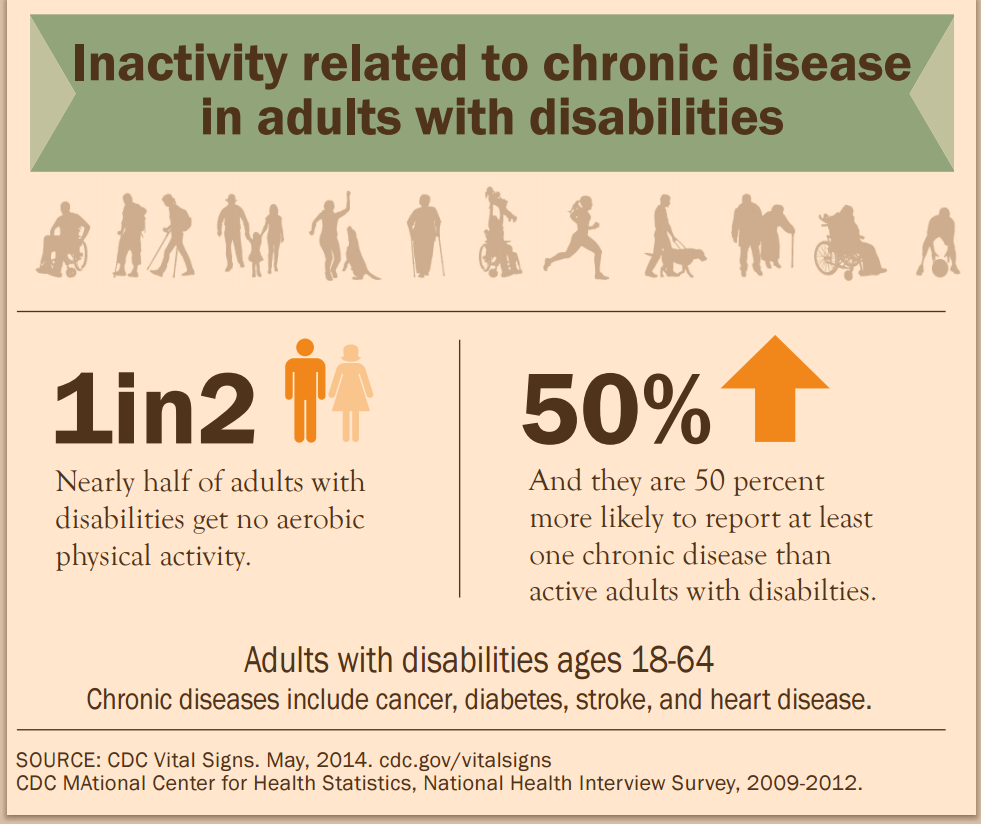
Inactivity is a major problem; and can compound existing health problems for people with mobility issues:
Companies such as Quest88 are now providing a range of disability aids and cycles that give disabled people a range of ways to become active. With the success of the London 2012 Olympics and Paralympics this market has seen an exponential increase over the last 3 years – improving people’s lives and boosting British manufacturing at the same time.
As technology continues to evolve at an exponential rate, point of sale is developing to correspond with customer’s expectations of speed and efficiency. The shift from traditional high street and in-store shopping, to online shopping, represents a demand for convenience. The rise of internet speeds, web-enabled mobile phones and the increase in the use of tablets like the Nexus and iPads; is good news for online retailers, but creates a separate issue of optimisation across channels.
The issue of Conversion Rate Optimisation across different platforms and technology is the subject of many articles, and many tutorials; however less is written about integration across platforms. Over the past 5 years, in order to meet customers’ preferences and to increase efficiency, a number of retailers have launched online kiosks in store.
The kiosks are able to provide the customers with detailed brand and product information at the touch of a button (or maybe a few buttons). They can also check availability of specific products and many kiosks now come complete with chip and pin technology, so that customers can effectively ‘self-serve’ themselves, and potentially avoid long queues and delays that are often seen in busy retails outlets. They can also potentially be integrated with mobile phones, remembering customer details, and even enabling customers to use coupons found online.
In the aftermath of the last British recession, people are demanding more product information and specifications before making a purchase. Kiosks are an ideal way of providing instant access to this information without over-stretching resources in terms of staff time and availability. In addition some larger stores stock thousands of products; with dozens available for a given purpose.
Kiosks can help people follow simple questions, and narrow down results to give one, or several products that perfectly fit the customer’s individual needs and requirements.
Kiosks can also provide retailers with additional information to fill their ever-expanding database of customer data. Customer journeys and ‘bottlenecks’ now have a whole new dimension; as does Conversion Rate Optimisation.
This information can be applied relatively easily, as most e-commerce kiosks can be updated with relative ease. Are in-store kiosks the Sales Assistants of the future? Hopefully not literally, but they can certainly be used to streamline store processes and optimise sales figures.
We all know the stat, well, approximately – 90% (ish) of businesses fail in the first year…
Most of us have dreams of starting a particular type of business. Be that as it may, when the fantasy turns into a reality, many don’t really have a clue about running or maintaining a business.
There is both an art and a science behind running a successful business. From the income administration through to the business’ operational procedure. There is a wealth of learning and data for organisations to influence, with the goal that they can control their business in the right course. From choosing the right accountant, to sorting out the company website; there is lots to learn, and fast, when you start your own business.
The longer it takes people to pick up and learn basic business procedures and best practices, the more money it will cost.
So what are a few things that they can do? All things considered, they can embrace courses that won’t upset their business hours and permit them to take in the essentials that will make their business develop. Courses are normally available on bookkeeping and business management at local vocational colleges.
The business must have clear and quantifiable objectives and Key Performance Indicators (KPIs). Without an unmistakable system, the business will be meandering heedlessly and there won’t be any reasonable strides for the associations movement. This will influence the business all in all and workers inside of the business. Choices that will influence the business’ development will dependably return to the business technique that is set up.
The business can just become effectively if there is an in number group of representatives, consultants and offices that are working towards the fruitful execution of the method. The business should have an in number ability securing procedure and needs to recognize and contract ability that will best execute the method for the business. The ability ought to be procured taking into account quantifiable results. Enlist a group of authorities that will be committed to dealing with the complete workload for one of the offices in the association, to guarantee that specific zone of the business is performing as per the dispensed targets.
Income is lord to a business. It is key for dealing with the development and money related danger to a business. The straightforward guideline is to keep expenses low and to keep income high. This likewise means overseeing organization income and benefit conjectures, and in addition watching out for operational expenses and to keep looking for approaches to minimize them.
Imagination is crucial for the business. By what means will the business keep on enhancing with anticipated buyer patterns and changes to nature, innovation and that’s just the beginning? Apple is one of the idea pioneers regarding the matter of development through outline. It’s this ground breaking that will permit the business to develop into a brand pioneer.
Build up the business’ novel worth suggestion.
The business needs to keep showing quality in its industry and to its purchaser market. What is it about the business that makes it a pioneer? The business ought to look to enhance its quality through accreditations, perceived industry affiliations, grants, testimonials and customer portfolios, to give some examples. The more the business enhances its apparent worth, the more open doors will emerge for the business to work with higher profile customers and for new business to go ahead autopilot.
Entrepreneurs and supervisors need to make a move in terms of satisfying the business technique. This must be accomplished by having an unmistakable heading and activity arrangement for the business. In the event that the work force inside of the association can take in the obliged activities as has been demonstrated by other effective organizations, they will make an in number open door for their business to well over the long haul.